Frequently Asked Natural Shade Questions:
Q: Why are the natural shades made in China? Could they be made in the USA?
A: Recent tariffs have caused a lot of customers to ask us why our natural shades are manufactured in China and if they could be made in the USA.
As a result, we thought it would be useful to give you an inside look at our production processes, so you can judge for yourselves.
Our production starts with raw material processing and weaving:
- All the fabrics we use are woven right at our factory as the raw materials are grown in China. Most of these materials are not available in large quantities anywhere else in the world.
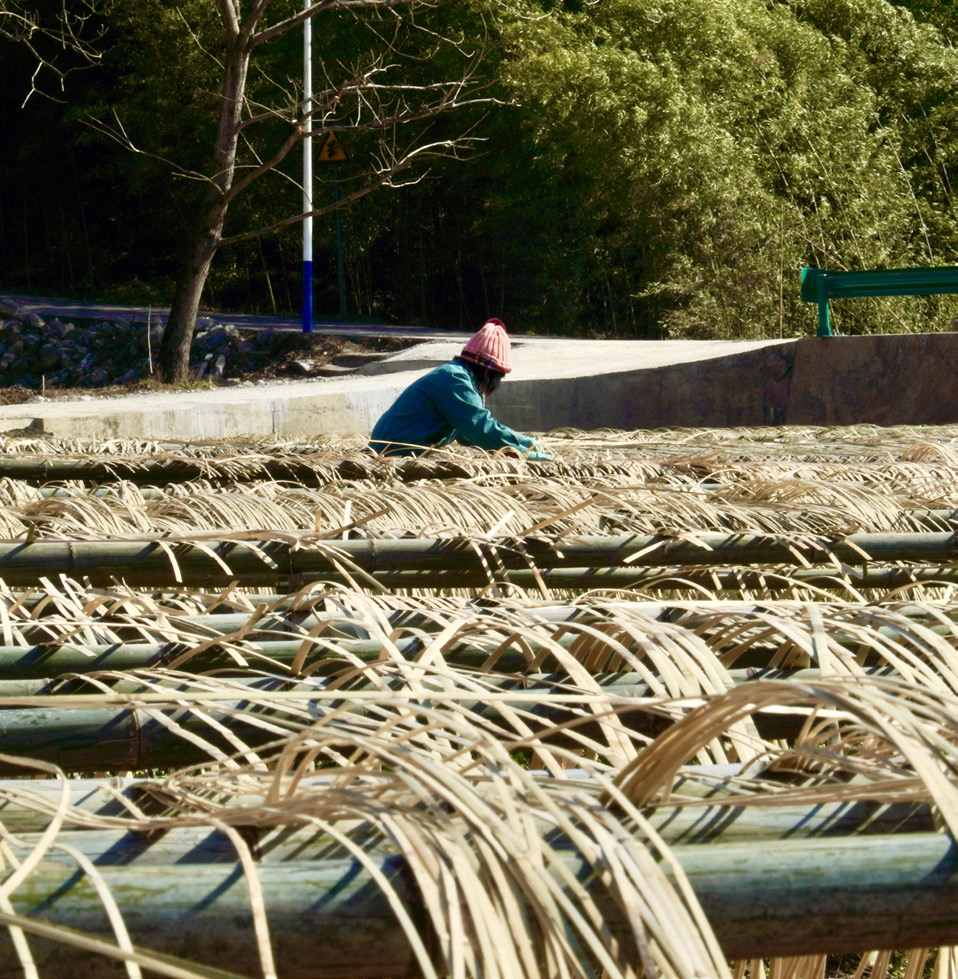
- Materials must be dried in the sun, sometimes for days, to achieve the right moisture content and color.
- Jute and hemp fibers must be tied into long strands for weaving. We have over 300 skilled workers doing just this, using traditional hand-knotting techniques.
- We have 358 manual weaving looms, and it can take 5 – 7 days to weave one roll of jute or linen. It takes 4 months to train a loom operator, and with manual weaving each loom needs at least one operator.
Finished rolls are then moved to the shade production area for assembly:
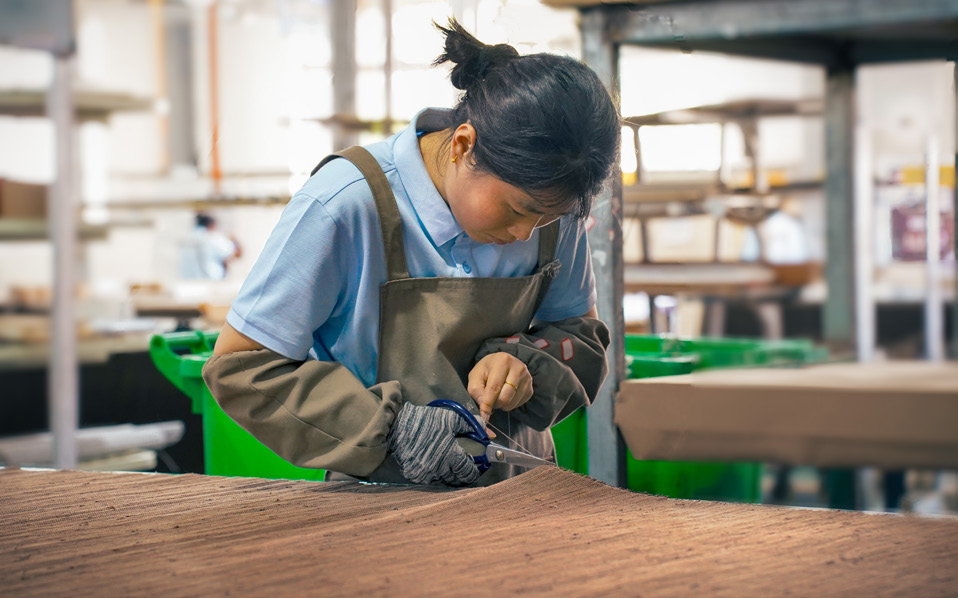
- Assembly begins with cutting the material from the roll, which is done by hand with pneumatic shears for bamboo or with scissors for jutes and linens.
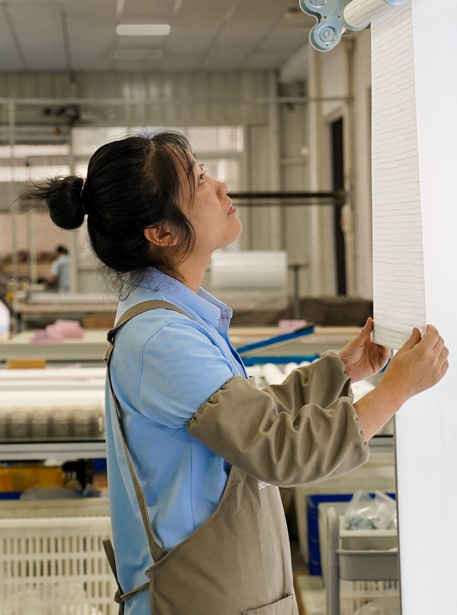
- All assembly operations are manual – attaching the fabric to the head rail, sewing rings, finishing the bottom rail, adding components, cording the shade, sewing liners and edge binding, adding the valance, and inspection/packing.
- Over 420 employees assemble shades, and each shade takes a total of 6 hours to create.
In summary, natural roman shade production is labor intensive and requires skilled and experienced workers. These workers come from the villages around our factory and that is one reason why we locate the production there.
The second reason is the close access to raw materials. We currently weave and stock over 1,000 different fabrics. Our inventory is over 6,000 rolls, or 3 million square feet of fabric. We would need many times more rolls than that to support manufacturing here in the USA with the time it takes to ship materials here, which is not economically viable.
So why have 1,000 fabrics?
Because that is what our customers want! There is a huge demand in the US market for natural materials in interior design – more so than in Europe or even in China.
Our customers are always looking for new colors and textures in a market that is defined by design, fashion trends, and aesthetics. This wide assortment allows us to make sure our customers can have exclusive product lines.
This close link between raw materials and production also fosters innovation. Recently we introduced a line of natural roller shades, which feature finer, more uniform fabrics, made from cellulosic fibers. We are also about to launch a revolutionary new line of natural honeycomb shades. These innovations come from being able to work hand-in-hand with the raw material suppliers.
The production of roller shades and honeycomb shades is very different to roman shades:
- There is far less labor involved.
- The work does not require the same level of artisanal skill.
- Fabric cutting and some other processes can be automated.
- Fabric selections are more limited, so the inventory required is less.
All those reasons mean that these products can be assembled cost-effectively in the USA, even if the fabrics will still need to be woven close to where the materials are harvested.
Assembly of these products in the USA could create well-paying jobs for people operating the machinery and cutting tables, finishing shades, and packing and shipping. This would also allow us to offer quick-ship products and lower freight costs.
Our Chinese factory is a willing partner to help us set this up and the exciting news is that we are actively working on this now.
We know tariffs can be a politically divisive issue, and they have caused us all extra costs in the short term. But as we adapt to the new trading environment, the outcome can be a more-balanced production footprint and supply chain, which will allow us all to continue to have access to the best products for your customers, at the right price. We look forward to updating everyone on our progress in this exciting new venture. 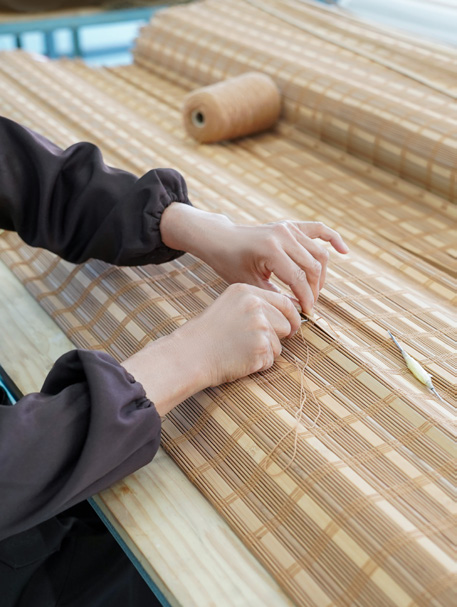
Was this article helpful?
That’s Great!
Thank you for your feedback
Sorry! We couldn't be helpful
Thank you for your feedback
Feedback sent
We appreciate your effort and will try to fix the article