DC HARDWIRED MOTOR INSTALLATION
DC hardwired motor (the DM25CE/S) is a 12 volt motor, also referred to as “low voltage” motor. This motor is a great solution for hardwiring, for when a shade is too narrow for the rechargeable Li-ion motor, or when the location makes Li-ion battery motor impractical.
During new construction or remodeling sometimes people will run low voltage wiring directly to the window, with the intention of direct wiring shades or possibly security cameras, which use the same type of wiring. The wires are left sticking out from the drywall, usually at the top corner of the window.
Typically, those wires all go back to a central location, like a technology closet or near the breaker panel, or if done post-construction they may run them into the attic above the windows to minimize drywall damage. They are bundled and not connected to any power source until needed.
WIRE GAUGE:
The further the distance between the window and the power source (ie the distribution panel), the thicker the wire needs to be so that it can carry the necessary power to travel the distance. When talking about wiring, the higher the gauge wire used, the thinner it is. For example, 18 gauge wire is thinner than 16 gauge wire. Therefore, higher gauge (thinner) wire should be used for shorter distances, lower gauge wire for longer distances. The gauge guide in the Smart Home Collection Distribution Panel user guide is a great tool to provide customers if you are involved BEFORE the project. Click here for DC Panel Gauge Guide or DC Power Distribution Panel Instructions
A Distribution Panel takes 110-220 volt AC power and converts it down to 12V DC power, which is needed by the DM25CE/S
FOR ELECTRICIANS:
- Every motor will need a minimum of 10.6 volts at each window.
- If the motor is not receiving at least 10.6V, it will beep just like the sound of the Li-ion battery motor when it needs recharged
- Every motor will need a minimum of 2 amps for startup and 1 amp for running
- If there is not sufficient amperage at the window the motor will either not start or will struggle to get started.
- These tests should be done by the electrician prior to installation. Voltage and Amperage meters are common tools for electricians.
- Is an electrician required for low voltage wiring? Not always in all areas, depending on local codes, but it’s best to encourage a customer to involve a professional and provide them with the gauge guide and motor specs.
The DM25CE/S motor has a lead wire with the male end of a “quick connect” piece at the end. When hardwiring this motor, the electrician can either snip off the quick connect end and wire the now bare wires to the wires coming from the window or use the provided WIRE HARNESS (preferred). The factory ships the wire harnesses packed with the brackets for the shade. A WIRE HARNESS is a 6” wire with the FEMALE end of the quick connect that the motor can plug into. See attached photo.
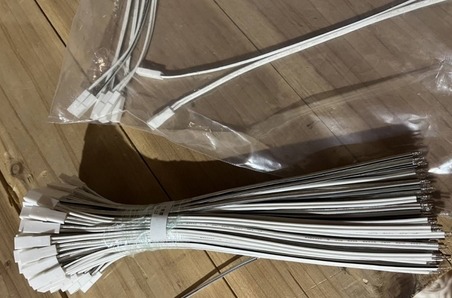
- The lead wire from the motor and the wire harness has two wires encased in white sheath – one is plain white and one has a black stripe down the side.
- The WHITE wire is LIVE
- The BLACK STRIPED wire is NEUTRAL
- What is the purpose of the wire harness? When connected to the wires leading from the window, it allows the shade installer to just connect the two ends of the quick connect and operate the shades. Additionally, if the customer ever wanted to remove the shades for painting, all they need to do is disconnect the quick connect parts and uninstall. If not used, (meaning the lead wire from the shade is directly connected to the wires at the window), an electrician would be needed to disconnect and reconnect the shades. That also might mean some drywall damage is necessary to unbury the joined wires.
TROUBLESHOOTING:
There is very little that can go wrong with the DM25CE/S motor. Usually if the shades aren’t working at all (especially if it’s multiple shades), it’s something to do with the wiring.
- Check to see that the Distribution Panel is powered. There should be lights inside the box that indicate it is receiving power. See attached photo.
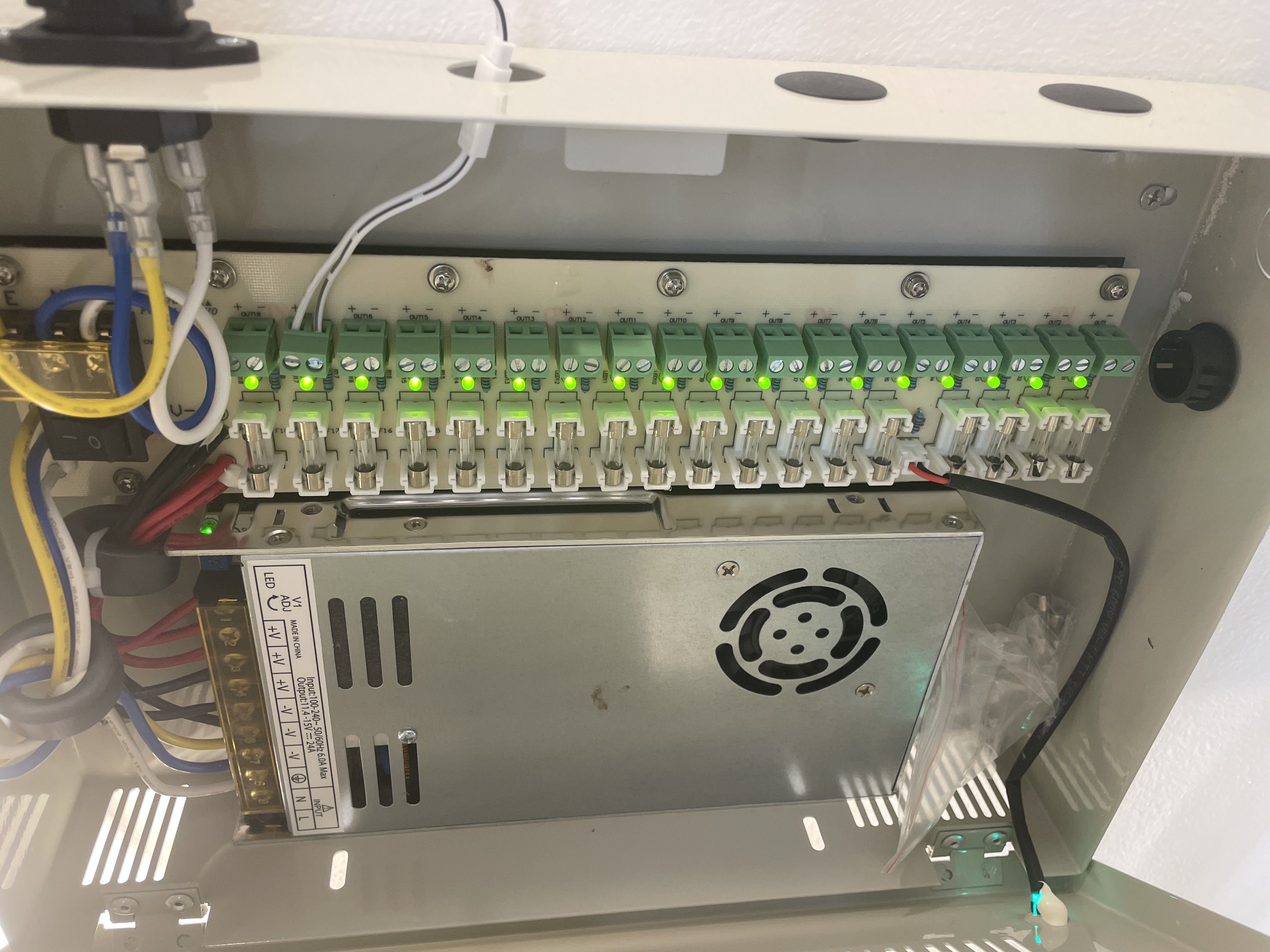
- Check to see that the lead wire and wire harness if used are connected properly. The plain white wire is live / positive, the black striped wire is neutral.
- Check to see that the remote / wall switch is functioning.
SOLUTIONS FOR WHEN A DC MOTOR IS NEEDED, BUT HARDWIRING IS NOT AN OPTION:
When would a DC motor be necessary if not for hard wiring? If the shade is too narrow for a rechargeable li-ion motor, or if the installation location makes recharging a li-ion motor impractical (ie super high windows)
- The motor can be powered by an external battery pack. The DC1276B is a rechargeable Li-ion battery pack that can power the shade. Each shade requires it’s own battery pack.
- Pro Tip: Encourage the customer to purchase extra DC1276B to have recharged at ground level, so when the battery at the shade needs charged they can just take one trip up the ladder to replace the battery pack, then recharge that one for the next swap.
- The motor can be powered by an external battery tube. The DC224K is a battery tube requiring 8 AA alkaline batteries. The factory recommends high quality batteries. The battery tube is not always the best solution because it is quite wide (roughly 18”), and if the DM25CE/S is being used for a narrow shade, sometimes the battery tube is wider than the window and can’t be hidden well.
- The motor can be permanently plugged in to an outlet using the DC1562US. This adapter has the female end of the quick connect on one end and a plug (transformer) on the other.
FINAL FUN FACT:
- All of the PD standard motor options (rechargeable Li-ion, Power Lift, DM25CE/S and DM25TE) are compatible with each other and with our remotes and Pro Hub, meaning you can mix and match all of these motors to suit an installation and they will all operate off the same remotes / hub.
Was this article helpful?
That’s Great!
Thank you for your feedback
Sorry! We couldn't be helpful
Thank you for your feedback
Feedback sent
We appreciate your effort and will try to fix the article